
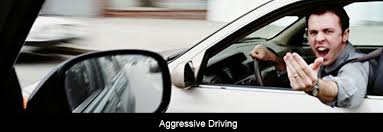
Road Rage and Aggressive Driving
There is a fine line between these two labels for driving behavior. Aggressive driving leads to road rage
either on the part of the driver or on the part of the victim. People who are aggressive drivers feel they “own the road.” They have little to no regard for other drivers and are reckless and dangerous.
These drivers have a lot of anger, resentment, and frustration and they take that with them when they get behind the wheel of a vehicle. Generally, aggressive drivers are those who are poorly educated with a high level of stress
and little ability to cope with that stress.
Road rage
is what results from an aggressive driver's driving habits. They generally have a short fuse and if you try to stop them from their unsafe behaviors, they become agitated and often violent.
What’s most surprising is that the aggressive driver often is not the main person involved in a road rage
incident. Road rage
results from aggressive driving in one of two ways:
1. The aggressive driver exhibits unsafe behavior and another driver attempts to stop that behavior. The aggressive driver becomes angry
that someone would stand up to him or her and that anger
comes out with unbridled rage.
2. The aggressive driver exhibits unsafe behavior and another driver becomes angered at the recklessness. He or she confronts the aggressive driver in a threatening way, thus precipitating a road rage incident.
Aggressive driving is a choice just as road rage is a choice. Studies have found that it’s a learned behavior as well. Unfortunately, hundreds of cases of road rage
each year end
with serious injuries or even fatalities.
Most drivers have feelings of road rage
because it is a cultural norm. People learn this behavior from childhood when being driven by parents and adults. Also, by the time adolescents begin to drive they have been exposed to thousands of hours of TV programs that feature drivers behaving badly or dangerously and getting away with it.
Legally there is a difference between "road rage" and "aggressive driving." Only a few states have enacted special aggressive driving laws. Road rage
cases are normally processed as assault and battery (with or without a vehicle), or "vehicular homicide."
Perhaps the biggest cause of unsafe highways is people's unwillingness to scrutinize their own conduct, preferring to blame other drivers. Surveys consistently show that most people have an inflated self-image of their motoring ability, rating the safety of their own driving as much better than the average motorist's.
To learn more about road rage, simply click on the links below:
Famous Quotes
Forgiveness Quotes
Anger Quotes
Self Esteem Quotes
Forgiveness Quotes
Anger Quotes
Self Esteem Quotes