
Anger Management Using the Compliment Sandwich
Do you ever find yourself getting more and more angry and frustrated while trying to explain what is bothering you? Perhaps you feel like others are not really listening to you or trying to understand things from your perspective. In such circumstances, you may end up raising your voice or becoming verbally or even physically abusive. Unfortunately, responding in this manner usually decreases your chances of being listened to with empathy and compassion.
Another maladaptive way of handling your feelings, perhaps out of fear of losing control, is to work extra hard at keeping everything bottled up inside. What happens here is similar to what happens when a balloon keeps filling up with more and more air. The balloon will expand as far as it can and then eventually pop.
However, if the balloon periodically releases some of its air, the likelihood is it will never reach that point of popping. Similarly, a person who uses assertive communication will be much less likely to become explosive. As one of the eight core anger management techniques, assertive communication involves honestly and effectively communicating your feelings while doing so in a nonhostile fashion.
Perhaps most challenging when using assertive communication is to express your feelings without the other person becoming angry or defensive. What makes this so difficult is that people, for the most part, do not like to be criticized. Telling somebody what they did wrong, what you do not like about their behavior, or how they hurt your feelings can very easily trigger a negative reaction.
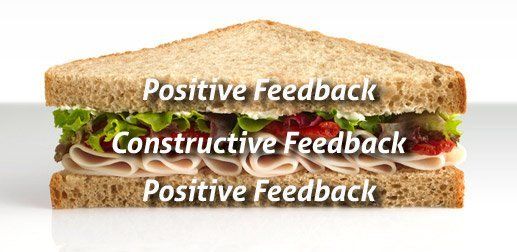
One of the most effective ways of using assertive communication is by using a technique known as the Compliment Sandwich. The meat of the sandwich (your complaint or concern) is surrounded by two pieces of bread (compliments or positive feedback). In order to minimize defensiveness, you would begin with a compliment (the first piece of bread), then present the main message that you are trying to communicate (the meat), and then finish with another compliment (the second piece of bread).
To help illustrate, here is an example of the Compliment Sandwich:
I have always considered you to be one of my best friends (first compliment / positive feedback).
So when I heard that you were talking behind my back, I felt really hurt. What I need is for you to talk to me directly and not get others involved (critical feedback).
You have always been there for me in the past and I know I can still count on you (second compliment / positive feedback).
As you can see in the aforementioned example, the Compliment Sandwich made it possible for an important communication to be made in a nonhostile manner. By opening and closing with positive feedback, a friendly tone was set and an important message was able to be conveyed. Rather than aggressively attack the other person and risk making matters worse or bottle things up and become potentially explosive, this type of communication allows one to get things off his or her chest without putting the other person on the defensive.
There are, however, a few key suggestions for using the Compliment Sandwich effectively. First, it is essential that your praise be genuine. As challenging as it may seem with some of the more difficult people in your life, you should be able to think of at least two things to say that are both complimentary and sincere. It may take some extra thought on your part, but there is almost always something positive that you can say.
It is also important to avoid overuse of this technique so that your words do not appear to be contrived. Finally, your compliments should in some way be related to the critical message that you are trying to convey. This is necessary in order for the conversation to flow smoothly and to feel genuine. Thus, the example provided earlier would lose its effectiveness if the compliments seemed to be out of left field (e.g., “I have always admired your dancing ability.” and “You are such a terrific football player.”). These compliments may be genuine, but have absolutely nothing to do with your friend talking behind your back.
By properly using anger management techniques such as the Compliment Sandwich, one can minimize the potential cost of anger. Health problems, impaired self-esteem, damaged relationships, emotional scarring of one’s children, and a drop in productivity at work are all potential outcomes of uncontrolled anger. On the other hand, when channeled properly, anger can have many benefits.
So the next time someone hurts your feelings or offends you, instead of bottling things up or exploding, why not try something new and give a compliment sandwich? You might be pleasantly surprised by the results.
More Articles by Dr. Becourtney
Helpful Links
Famous Quotes
Forgiveness Quotes
Anger Quotes
Self Esteem Quotes
Forgiveness Quotes
Anger Quotes
Self Esteem Quotes